Search This Blog

Showing posts with label 1939. Show all posts

1939 - December 19

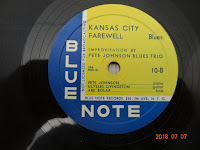
Pete Johnson Blues Trio - December 19 1939

Dan Morgenstern - Reminiscing At Blue Note CD Liner Notes

Pete Johnson (1904-1967) was one of the masters of mature boogie woogie, and one of the triumvirate that brought the style to national attention via John Hammond, who had recorded Mead Lux Lewis as early as 1935.  A native of Kansas City, Johnson had the lightest of touches and was...an adept, all-around jazz player. He was featured (with Albert Ammons and Meade Lux Lewis) at the famous 1938 "Spirituals to Swing" concert produced by Hammond. At the time of this session for Blue Note, he was ensconced at CafĂ© Society in Greenwich Village.

Blue Note Records Biography 

Pete Johnson was one of the three great boogie-woogie pianists (along with Albert Ammons and Meade Lux Lewis) whose sudden prominence in the late ’30s helped make the style very popular. Originally a drummer, Johnson switched to piano in 1922. He was part of the Kansas City scene in the 1920s and ’30s, often accompanying singer Big Joe Turner. Producer John Hammond discovered him in 1936 and got him to play at the Famous Door in New York. After taking part in Hammond’s 1938 Spirituals to Swing Carnegie Hall concert in 1938, Johnson started recording regularly and appeared on an occasional basis with Ammons and Lewis as the Boogie Woogie Trio. He also backed Turner on some classic records. Johnson recorded often in the 1940s and spent much of 1947-1949 based in Los Angeles. He moved to Buffalo in 1950 and, other than an appearance at the 1958 Newport Jazz Festival, he was in obscurity for much of the decade. A stroke later in 1958 left him partly paralyzed. Johnson made one final appearance at John Hammond’s January 1967 Spirituals to Swing concert, playing the right hand on a version of “Roll ‘Em Pete” two months before his death. ~ Scott Yanow 

Stanley Dance - Pete Johnson / Earl Hines / Teddy Bunn Sessions Mosaic Records

Did a drummer fail to turn up? The absence of one certainly suggest that, but then one may recall the Port of Harlem Jazzmen session on which Frank Newton and J.C. Higginbotham, on trumpet and trombone respectively, were backed by a four piece rhythm section.

Pete Johnson didn't really need any backing at all. Of all the boogie woogie pianists, he was the best equipped technically and the one with the most accurate left hand. Lion knew this well enough, and on Holler Stomp and You Don't Know My Mind the pianist plays alone.

DM

[Holler Stomp] stands with Johnson's best display pieces at fast tempo. The relentless left-hand ostinatos hold the tempo rock-steady, while the right offers all sorts of changing patterns and riffs, trills, etc. The other solo piece...is much more reflective in mood - a mellow performance that gets into the essence of the blues.

In other pieces, Johnson is abetted by the guitar of Ulysses Livingston, then with Benny Carter's big band, and bassist Abe Bolar, an alumnus of the famous Blue Devils and the band of Hot Lips Page. They add textural variety, but Pete was a rhythm section all to himself.


Alfred Lion, Max Margulis with the Pete Johnson Trio

Richard Havers - Uncompromising Expression - Thames and Hudson

Pete Johnson's Blue[s] Trio was both the last recorded session of 1939 and the first since the outbreak of the war in Europe, which saw Lion joined by his old friend from Berlin, Francis Wolff. 


Richard Cook - Blue Note Records A Biography - Secker and Warburg

Frank Wolff arrived in New York at the end of 1939 (by legend, on the 'last boat out of Nazi Germany'). He had worked in Germany as a professional photographer. Alfred had met Wolff as far back as 1924 and the two teenage boys discovered a mutual interest in popular music. Wolff proved to be, in the long term, the real business brain behind Blue Note. They managed to sustain a tiny office on West 47th Street, Blue Note's first address.

Downbeat – February 15 1940 – Volume 7 Issue 4 


Pete Johnson 

“Barrelhouse Breakdown” & “Kansas City Farewell” and “Holler Stomp” & “You Don’t Know My Mind,” Blue Note 10 & 12, $1.50 each, both 12 inches 


The greatest and most musical boogie pianist lives up to expectations here, appearing in better form on the latter two sides, which are strictly solos. First two show Johnson with Abe Bolar, bass, and Ulysses Livingston, guitar accompanying. Breakdown is fast and not up to Pete’s par. Farewell, a slow blues. Seeps with sincerity and must stand as a truly great performance. Holler is fast, stompy boogie piano while You Don't Know is a non-boogie, slow blues performance. Utterly non-commercial, Johnson's improvisations are breath-taking all the way. This column has long shouted of Johnson’s prowess. It is gratifying to know he is finally beginning to be appreciated and that a firm like Blue Note – which deserves patronage of all musicians and collectors —has the initiative to preserve Johnson’s boogieisms in permanent form. 


The American Record Guide – April 1940 – Volume 5 Issue 12 


Kansas City Farewell and Barrelhouse Breakdown; Pete Johnson’s Blue Trio, Blue Note No. 10, price $1.50 

Vine Street Bustle; and Some Day Blues; Pete Johnson’s Blue Trio, Blue Note No. 11, price $1.50 

You Don’t Know My Mind; and Holler Stomp; piano solos by Pete Johnson, Blue Note No. 12, price $1.50 

(Personnel of the Trio is: Pete Johnson, piano. Ulvsses Livingston. guitar; and Abe Bolar, bass.)  
 
Blue Note will be the despair of reviewers yet! There is nothing a critic enjoys better than finding a fault to write about. But what fault we find with a single Blue Note issued so far? True, they have not all been of equal quality. There were spots here and there that were not entirely satisfactory. but on the whole, there is sincerity of perceptible in each of the discs issued so far.  
 
The outstanding side in this group is Some Day Blues. First of all it is built around an excellent slow blues theme, and it is played by all with equal fervor. It is one of those themes that could go and on through endless variations without tiring either the players or the listeners. In fact. it ends rather abruptly as if everyone concerned were so engrossed with the music that mechanical limitations were forgotten. The recording is excellent.  
 
Honors are equally divided between Johnson and Livingston, with Bolar lending excellent support.  
 
Second honors go to You Don't Know My Mind which is conceived in much the same mood as Some Day Blues but for a solo instrument. But in spite of its aural and emotional appeal, it is thematically and technically inferior.  
 
Kansas City Farewell is also a slow blues on a good theme but its effect is lost in poorly balanced recording. The piano is too prominent ; the guitar is weakly recorded; and the bass is so badly out of focus that it is hardly more than a blurred boom throughout the disc. 

The other three numbers are boogie woogies which are distinguished chiefly by the virtuosity of Pete Johnson, who is a past master with such music. Plenty of vim, vigor, and vitality but not much feeling.  
 
Incidentally, all three discs were made at the same session. Pete Johnson chose his companions, one of whom. Abe Bolar, once played with him years ago in Kansas City honky tonks. Livingston was chosen because of the impression he had made at a jam session at CafĂ© Society when Johnson was playing there. All the numbers were unprepared and perfectly spontaneous. 


Down Beat – 15 March 1940 – Volume 7 Issue 6 


“Some Day Blues” & “Vine Street Bustle,” Blue Note 11, a 12-inch album. 


The of last pair of platters (he made six in all) show him in fine fettle. Abe Bolar, bass, and Ulysses Livingston on guitar work more effectively here than they did on Barrelhouse Breakdown and Kansas City Farewell, and Pete's Steinway stylings reveal him at his best on slow blues and a more animated boogie. Bustle jumps nicely while Some Day is more emotional, in slower tempo. 


661-9 Test Pressing


Session Information
Reeves Sound Studios, NYC, December 19, 1939

Pete Johnson, piano; Ulysses Livingston, guitar #1-3,7,8; Abe Bolar, bass #1-3,7,8

RS653-1 Vine St. Bustle Blue Note 11, BLP 7019, BLP 1209
RS654-2 Some Day Blues rejected
RS655-3 Some Day Blues Blue Note 11, BLP 7019, BLP 1209
RS656-4 Holler Stomp rejected
RS657-5 Holler Stomp -
RS658-6 Holler Stomp Blue Note 12, BLP 7019, BLP 1209
RS659-7 Barrelhouse Breakdown Blue Note 10, BLP 7019, BLP 1209
RS660-8 Kansas City Farewell Blue Note 10, BLP 7019, BLP 1209
RS661-9 You Don't Know My Mind rejected
RS662-10 You Don't Know My Mind Blue Note 12

Sources and attribution:

Dan Morgenstern - Reminiscing At Blue Note - CD-8-28893-2
Richard Cook - Blue Note Records - Secker and Warburg
Stanley Dance - Pete Johnson / Earl Hines / Teddy Bunn Sessions - MR1-119
Richard Havers - Uncompromising Expression - Thames and Hudson


1939 - July 29

Earl "Fatha" Hines - July 29 1939

Bluenote.com

Once called “the first modern jazz pianist,” Earl Hines differed from the stride pianists of the 1920s by breaking up the stride rhythms with unusual accents from his left hand. While his right hand often played octaves so as to ring clearly over ensembles, Hines had the trickiest left hand in the business, often suspending time recklessly but without ever losing the beat

Dan Morgenstern - Reminiscing At Blue Note

Earl Hines (1903-1983), dubbed "Fatha" and certainly the progenitor of modern jazz piano. By 1939, when [Alfred] Lion managed to entice him to do this date, he had been leader of his own big band for a decade and hadn't waxed a solo performance since 1932. He'd been absent from the studios with his band for 16 months when, two weeks earlier, he did his first session for Victor's Bluebird label; that's probably how Lion got away with recording him - the Bluebirds hadn't yet hit the street.

Stanley Dance - Pete Johnson / Earl Hines / Teddy Bunn Sessions

In his later years, Earl Hines could not remember how he came to record two titles for Blue Note...but he thought maybe he kept a promise to Alfred Lion and sneaked in under the wire before an exclusive contract [with Bluebird] was signed. In any event, it was a scoop for the independent label. All Lion could remember about the session when Michael Cuscuna asked him was that Hines gave him the title for the first number....

DM 

Legend has it that the title of the first piece was given to Hines as he raced down the studio stairs to make a train to Chicago.

Or.... 


Michael Cuscuna – Blue Note Photos – Francis Wolf 

On the 29th of July 1939, Blue Note scored a bit of a coup by convincing Earl £Fath” Hines, already a legend in jazz, to cut two marvelous improvised piano solos. Hines literally took the money and ran. Alfred told me: “I followed him down the street to get titles for the pieces from him. He was so fast that I just watched him put on his jacket and dash down the sidewalk. So I called one of the pieces The Father’s Getaway.” 


Richard Cook - Blue Note Records: The Biography – Secker and Warburg 2001 

'The Father's Getaway" and "Reminiscing at Blue Note" are full of the authentic Hines razzle-dazzle, skipping over rhythmic and harmonic conventions with insouciant abandon, the kind of solo he would live by in later years but which was rarely exposed, at length, in his prime. Lion let both masters run over four minutes and secured a priceless result.

SD

"The Father's Getaway" was an apt title for a performance played in the same stream-of-consciousness style that made his 57 Varieties world famous.

This kind of piano playing is, of course, how the great masters of yesterday liked to entertain and challenge one another. There is more of it on the equally well-titled Reminiscing At Blue Note, where familiar themes...surface briefly.

Gramophone Shop Supplement August 1939


The American Record Guide – August 1939 Volume 5 Issue 4 Blue Note announces a new disc to be available about August 1st. It is a piano solo record by [Earl “Father” Hines, the first solo recording made of him in years. This disc, which will be release No. 5, will be a twelve-incher containing The Father's Getaway and Reminiscing at Blue Note. It will be reviewed in this column as soon as it is received.


The American Record Guide – September 1939 Volume 5 Issue 5 


The Father’s Getaway / Reminiscing at Blue Note – piano improvisations by Earl "Father” Hines. Blue Note No. 5, 12-inch, price $1.50 
 
The Getaway is a fast number in typical Hines tempo. phrasing. and technique. His hand has lost none of its old-time skill. You may ask: why should it. he has been playing the same all these years? True. but other pianists have since appeared who had new and interesting things to say. They took some of the limelight away from him and for many years he has played in the dark. But when listening to this record one realizes that the Father is still the Father. There is nothing corny about his playing in spite the years. And in his playing can be found the germ of many other pianists' ideas and technique.  
 
Reminiscing is a trifle slower in tempo, more whimsical, but essentially the same as the reverse: the familiar phrasing. touch, and swing is there. This is improvisation at its best. It has a bounce that is infectious — and it is achieved without heel-pounding or bass exaggerations.  
 
Ten years ago this disc would have been sensation. It is no less a sensation today because it still speaks the same fundamental truths. What was good jazz then is still good jazz now.  


Down Beat September 1939 Volume 6 Issue 9 Hines presents his first recorded solos since he made those on Vocalion and Q. R. S. several years back. Nor does he lend credence to the statement some have made about his “lost” skill, for on these sides we forget the cigar-smoking, arrogant Earl that led a band so cockily in Chicago last spring. Evidently Earl can play with his old fire, under proper conditions. Even so, two 12-inch sides are adequate. Hines does not swing with the abandon of Waller, Stacy, Kyle, James P. Johnson or a halfdozen other pianists of today. Playing these several times will substantiate that statement.

Session Information

possibly WMGM Radio Station, NYC, July 29, 1939

Earl "Fatha" Hines, piano.

GM301x-3 The Father's Getaway Blue Note 5, BST 89902
GM302x-2 Reminiscing At Blue Note Blue Note 5
Sources and attribution:

Dan Morgenstern - Reminiscing At Blue Note - CD-8-28893-2
Richard Cook - Blue Note Records - Secker and Warburg
Stanley Dance - Pete Johnson / Earl Hines / Teddy Bunn Sessions - MR1-119

1956 - March 12

Kenny Burrell – March 12 19 56     Leonard Feather: Kenny Burrell Volume 2 Liner Notes   KENNY BURRELL is a guitarist summa cum plectrum. H...